Showing posts with label Accounting Basic. Show all posts

Thursday, January 23, 2014

Cornerstones of Financial Accounting (with 2011 Annual Reports: Under Armour, Inc. & VF Corporation), 3rd Edition, Jay Rich

http://www.amazon.com/gp/product/1133943977/ref=as_li_ss_tl?ie=UTF8&camp=1789&creative=390957&creativeASIN=1133943977&linkCode=as2&tag=bestaccounting-20


Get where you need to be with CORNERSTONES OF FINANCIAL ACCOUNTING. Cornerstones delivers a truly unique learning system that is integrated through the entire introductory managerial accounting journey -- ensuring students will leave the course with the knowledge they need to be future business leaders. Students are guided through: Building A Strong Foundation: Students need to build a strong foundation of the fundamentals before they can move forward in this course. The unique Cornerstones approach gets them through the fundamentals FASTER so that they can transition to analyzing and applying concepts. Understanding Relationships: Rather than focusing on concepts in isolation, students should understand accounting as a system and recognize how the end result changes based on how the numbers affect each other. CORNERSTONES aids students in this step as an important part in training them to be good decision makers. Making Decisions: Armed with the knowledge they have gained from working through the other aspects of the Cornerstones approach, students are now given the tools to bring their knowledge full-circle and practice making good business decisions. Students love this approach because it presents materials the way they learn. Instructors love it because it gets students to master the foundations more quickly and allows more time to learn and apply the analysis and decision making of accounting.

Review
"The cornerstones are the feature that sets this book apart. The explanations of key skills are clear, concise, and easy for students to find."

"Has a wide variety of exercises and problems. Presents examples in a clearly understood format."

About the Author
Jay Rich is a Professor of Accounting at Illinois State University. He received his B.S., M.S., and Ph.D. from the University of Illinois. Prior to entering the Ph.D. program, he worked as an auditor at Price Waterhouse & Co. in Chicago and earned his C.P.A. in 1985. He has published articles in The Accounting Review, Auditing: A Journal of Practice & Theory, Accounting Horizons, Organizational Behavior and Human Decision Processes, Accounting Organizations and Society, and others. He has also served on the editorial board of Auditing: A Journal of Practice & Theory and Current Issues in Auditing. Dr. Rich has received both the Outstanding Dissertation Award and Notable Contribution to the Literature Award from the Audit Section of the American Accounting Association. His primary teaching interest is financial accounting and he has taught numerous courses at the undergraduate, masters, and doctoral levels. His outside interests include his family, travel, reading, and watching sports, but he spends most of his free time driving his children to various activities. He also repeatedly develops plans to exercise and diet at some point in the future. By all accounts, he is a master at grilling meat, a mediocre skier, and a shameful golfer.

Jefferson P. Jones is the PricewaterhouseCoopers Associate Professor of Accounting in the School of Accountancy at Auburn University. He received his Bachelor's in Accounting and Master of Accountancy degrees from Auburn University and his Ph.D. from Florida State University. His research interests focus on financial accounting, specifically investigating the quality of reported accounting information. He has published articles in numerous journals, including ADVANCES IN ACCOUNTING, REVIEW OF QUANTITATIVE FINANCE AND ACCOUNTING, ISSUES IN ACCOUNTING EDUCATION, INTERNATIONAL JOURNAL OF FORECASTING, and THE CPA JOURNAL. Professor Jones has received numerous teaching awards, including the Outstanding Master of Accountancy Professor Award; the Beta Alpha Psi Outstanding Teaching Award (six times); the Auburn University College of Business McCartney Teaching Award; and the Auburn University School of Accountancy Teaching Award. In addition, he has made numerous presentations around the country on research and pedagogical issues. He holds a CPA certificate in the state of Alabama (inactive) and is a member of the American Accounting Association, the American Institute of Certified Public Accountants (AICPA), and the Alabama Society of CPAs (ASCPA). He has had public accounting experience as an auditor for Deloitte & Touche. Professor Jones is also a coauthor of Cornerstones of Financial Accounting. He is married, has two children, and enjoys playing golf and watching college football.

Maryanne M. Mowen is Associate Professor Emerita of Accounting at Oklahoma State University. She currently teaches online classes in cost and management accounting for Oklahoma State University. She received her Ph.D. from Arizona State University. She brings an interdisciplinary perspective to teaching and writing in cost and management accounting, with degrees in history and economics. She has taught classes in ethics and the impact of the Sarbanes-Oxley Act on accountants. Her scholarly research is in the areas of management accounting, behavioral decision theory, and compliance with the Sarbanes-Oxley Act. She has published articles in journals such as Decision Science, The Journal of Economics and Psychology, and The Journal of Management Accounting Research. Dr. Mowen has served as a consultant to mid-sized and Fortune 100 companies and works with corporate controllers on management accounting issues. She is a member of the Northern New Mexico chapter of SCORE and serves as a counselor, assisting small and start-up businesses. Outside the classroom, she enjoys hiking, traveling, reading mysteries, and working crossword puzzles.

Don R. Hansen is Arthur Andersen Professor of Accounting and a Regents Service Professor at Oklahoma State University. He received his Ph.D. from the University of Arizona in 1977. He has an undergraduate degree in mathematics from Brigham Young University. His research interests include activity-based costing and mathematical modeling. He has published articles in both accounting and engineering journals including The Accounting Review, The Journal of Management Accounting Research, Accounting Horizons, and IIE Transactions. He has served on the editorial board of The Accounting Review. His outside interests include family, church activities, reading, movies, and watching sports.

Product Details :
  • Hardcover: 832 pages
  • Publisher: Cengage Learning; 3 edition (January 1, 2013)
  • Language: English
  • ISBN-10: 1133943977
  • ISBN-13: 978-1133943976
  • Product Dimensions: 11.4 x 9.2 x 1.3 inches

More Details about Cornerstones of Financial Accounting (with 2011 Annual Reports: Under Armour, Inc. & VF Corporation), 3rd Edition

Tuesday, January 21, 2014

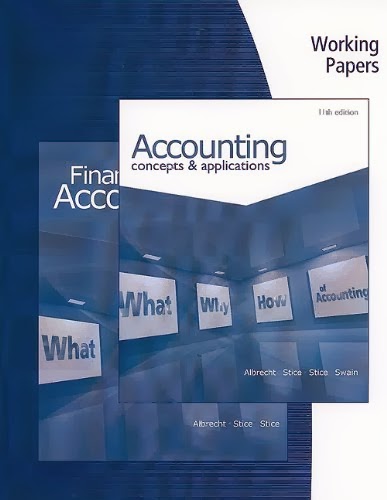
Working Papers for Albrecht/Stice/Stice/Swain's Accounting: Concepts and Applications, 11th Edition, W. Steve Albrecht

http://www.amazon.com/gp/product/0538750197/ref=as_li_ss_tl?ie=UTF8&camp=1789&creative=390957&creativeASIN=0538750197&linkCode=as2&tag=bestaccounting-20


Verified to ensure accuracy and quality consistent with the text, the working papers for the problems are provided together in one convenient resource.

About the Author
W. Steve Albrecht is the Andersen Alumni Professor of Accountancy in the Marriott School of Management at Brigham Young University. He has done extensive research on business fraud and ethics, resulting in the publication of more than 100 articles in professional and academic journals, several awards, and having one of the Association of Certified Fraud Examiners headquarters named after him. He received a bachelor's degree in accounting from BYU and MBA and PhD degrees from the University of Wisconsin. He is a Certified Public Accountant, Certified Internal Auditor, and Certified Fraud Examiner. Dr. Albrecht has consulted with numerous organizations, including Fortune 500 companies, major financial institutions, the United Nations, FBI, and other organizations, and has been an expert witness in over 35 major fraud cases.

Earl K. Stice is the PricewaterhouseCoopers Professor of Accounting in the School of Accountancy at Brigham Young University, where he has been on the faculty since 1998. He holds bachelor's and master's degrees from Brigham Young University and a PhD from Cornell University. Dr. Stice has taught at Rice University, the University of Arizona, Cornell University, and the Hong Kong University of Science and Technology (HKUST). He won the Phi Beta Kappa teaching award at Rice University, was twice selected as one of the ten best lecturers on campus at HKUST, and has won the Marriott School Teaching Award at BYU. Dr. Stice also has taught in a variety of executive education and corporate training programs in the United States, Hong Kong, China, Malaysia, and South Africa, and he has been on the executive MBA faculty of the China Europe International Business School in Shanghai, HKUST, the University of Illinois, and INSEAD (in Singapore).

He has published papers in the JOURNAL OF FINANCIAL AND QUANTITATIVE ANALYSIS, THE ACCOUNTING REVIEW, REVIEW OF ACCOUNTING STUDIES, JOURNAL OF BUSINESS, FINANCE, AND ACCOUNTING, and ISSUES IN ACCOUNTING EDUCATION. Dr. Stice has presented his research results at seminars in the United States, Finland, Taiwan, Australia, and Hong Kong. He has coauthored several accounting texts including INTERMEDIATE ACCOUNTING, 17TH EDITION. Dr. Stice and his wife, Ramona, have seven children -- Derrald, Han, Ryan Marie, Lorien, Lily, Taraz, and Kamila - and one adorable granddaughter.

James D. Stice is the Distinguished Teaching Professor in the Marriott School of Management at Brigham Young University. He is currently Associate Dean of the Marriott School. Dr. Stice served for eight years as the director of BYU's MBA Program. He holds bachelor's and master's degrees in accounting from BYU and a PhD in accounting from the University of Washington. Professor Stice has been on the faculty at BYU since 1988. During that time, he has been selected by graduating accounting students as "Teacher of the Year" on numerous occasions; he was selected by his peers in the Marriott School at BYU to receive the "Outstanding Teaching Award" and he was selected by the University to receive its highest teaching award, the Maeser Excellence in Teaching Award. Professors Stice has taught in academic and executive education programs in the United States, Europe, South Africa and China for such companies as IBM, Bank of America, and Ernst & Young. Professor Stice has published articles in JOURNAL OF ACCOUNTING RESEARCH, THE ACCOUNTING REVIEW, DECISION SCIENCES, ISSUES IN ACCOUNTING EDUCATION, THE CPA JOURNAL, and other academic and professional journals and has written several accounting textbooks. In addition to his teaching and research, he currently serves on the board of directors of Nutraceutical Corporation. Dr. Stice and his wife, Kaye, have seven children and eight grandchildren.

Product Details :
  • Paperback: 320 pages
  • Publisher: Cengage Learning; 11 edition (March 3, 2010)
  • Language: English
  • ISBN-10: 0538750197
  • ISBN-13: 978-0538750196
  • Product Dimensions: 0.7 x 8.2 x 10.6 inches

More Details about Working Papers for Albrecht/Stice/Stice/Swain's Accounting: Concepts and Applications, 11th Edition

Monday, December 30, 2013

Cost Accounting, 9th Edition, Michael R. Kinney

http://www.amazon.com/gp/product/1111972095/ref=as_li_ss_tl?ie=UTF8&camp=1789&creative=390957&creativeASIN=1111972095&linkCode=as2&tag=bestaccounting-20


The ninth edition of Kinney/Raiborn's COST ACCOUNTING: FOUNDATIONS AND EVOLUTIONS provides in-depth coverage of current cost management concepts and procedures in a straightforward and reader-friendly framework. The clean, concise presentation of materials and the updated illustrations reinforce and clarify the topics that readers traditionally struggle with most. In addition, real-world examples and ethical coverage are woven into the text so readers immediately see the relevance of the cost accountant's role in managerial decisions and learn to go beyond the numbers and think critically. Ensure mastery of the procedural and decision-making skills needed for future success with the Comprehensive Review Module, an array of newly improved end of chapter assignments, and the powerful, newly enhanced CengageNOW online learning and teaching system.

Review
"I prefer the Cost Management text over the Horngren in all 3 respects, organization, completeness and depth of coverage, but mostly the simplicity with which the information has been presented. The exhibits in the Cost Management text are also superior to the Horngren text, in my opinion."

"Kinney has better organization. The graphics are cleaner as is the color scheme and page layout. There is a slightly better inclusion of technology and modern management concepts. The end of chapter problems are more inclusive of the chapter’s material."

"Kinney does a far superior job in integrating real-world data throughout the text. I really liked Exhibits 6-1 and 6-2 which do a great job in illustrating process costing techniques with a real company. I like the way the company information and processes are integrated throughout the chapter--this type of integration is far superior to Horngren’s video presentations." --This text refers to an out of print or unavailable edition of this title.

About the Author
Professor Michael R. Kinney joined the faculty of accounting at Texas A&M (College Station) in 1989 after receiving a Ph.D. in Accounting from the University of Arizona. He is currently a KPMG Faculty Fellow of Accounting. He has taught undergraduate courses in cost and management accounting and graduate courses in management control systems, cost management, management consulting, corporate taxation, partnership taxation, and corporate tax strategies. He has received teaching awards including the outstanding teacher of the Texas A&M College of Business from the College of Business Honors Society (twice), and Delta Iota Chapter's Beta Alpha Psi teaching excellence award in accounting (twice) and the Association of Former Students Distinguished Achievement Award for Teaching. Professor Kinney has co-authored numerous articles in accounting, taxation, and finance as well as co-authoring ten college textbooks on management accounting and cost management. Dr. Kinney has also conducted consulting and executive development projects for several large Texas-based companies. Currently, Dr. Kinney serves as the Ph.D. Program Coordinator for the Department of Accounting.

It was fast, cheap, and worth the purchase. This book was exactly the edition I was looking for. Shipping was fast and the condition of the book is very good.

Product Details :
  • Loose Leaf: 848 pages
  • Publisher: Cengage Learning; 9 edition (May 31, 2012)
  • Language: English
  • ISBN-10: 1111972095
  • ISBN-13: 978-1111972097
  • Product Dimensions: 0.9 x 8.6 x 10.6 inches

More Details about Cost Accounting, 9th Edition

Performance Dashboards and Analysis for Value Creation (Wiley Finance), 1st Edition, Jack Alexander

http://www.amazon.com/gp/product/0470047976/ref=as_li_ss_tl?ie=UTF8&camp=1789&creative=390957&creativeASIN=0470047976&linkCode=as2&tag=bestaccounting-20


No matter what industry your company competes in, you need to have a firm understanding of how to create a direct link between shareholder value and critical business processes in order to improve performance and achieve long-term value. Performance Dashboards and Analysis for Value Creation contains the information and expertise you need to do just this—and much more.

From the Inside Flap
One of the primary objectives of today's corporate manager or director is to create value for the company's shareholders. Yet many managers and most employees still have difficulty in fully understanding the drivers of shareholder value and how their activities relate to these drivers.

With numerous years of experience in the world of finance—most recently as the founder and President of Value Advisory Group, LLC—author Jack Alexander knows what it takes to build long-term value in today's competitive business environment. And now, in Performance Dashboards and Analysis for Value Creation, he wants to show you how.

Straightforward and accessible, this timely resource will assist you in developing a comprehensive understanding of valuation and creating a direct link between shareholder value and critical business processes. Divided into three information-packed parts, Performance Dashboards and Analysis for Value Creation includes: Part One, Creating Context and Covering the Basics, provides a foundation for the concepts utilized in the Value Performance Framework (VPF)—a performance management system developed by Alexander—including basic finance concepts and valuation principles. Part Two, Linking Performance and Value, presents key elements of the VPF. Each of the value drivers—sales growth, relative pricing strength, operating effectiveness, capital effectiveness, cost of capital, and the intangibles—are linked to critical business activities and processes; and key performance measures, analytical models, performance dashboards, and tools for improving each value driver are explored in depth. Part Three, Driving Performance and Value, examines how the concepts and tools outlined throughout the book can be used to improve business performance and build long-term shareholder value. Effective implementation of dashboards as part of a comprehensive performance management framework (PMF) is discussed, and key findings—based on the author's benchmark study of performance and shareholder value—are reviewed.

To drive home the points discussed throughout the book, a companion website has been included. The analytical models and sample performance dashboards found on this website are the perfect way to begin developing dashboards and analysis for your specific needs.

Many companies use performance measures, but only a few have achieved the full potential benefits that a well-designed and implemented performance management framework has to offer. No matter what industry your company competes in, you need a way to measure, monitor, and manage the key activities and processes required to improve business performance and achieve long-term value. Performance Dashboards and Analysis for Value Creation contains the information and expertise you need to do just this—and much more.

From the Back Cover
Praise for Performance Dashboards and Analysis for Value Creation

"Beyond academic theory, I have witnessed firsthand Alexander's framework-driven concepts improve firm profitability and value. This is a required read for shareholder-friendly executives." —William W. Benton, CFA, Investment Analyst, William Blair & Company, LLC

"Drawing on his rich and varied experience as CFO, business consultant, and professor of financial management, Jack Alexander offers a practical approach to effective performance management in any company. This clear and concise reference is a must-read for anyone trying to understand and leverage the true drivers of shareholder value." —Earl T. Kivett, retired partner and director emeritus, Bain & Company, Inc.

"Creating long-term shareholder value is the fundamental responsibility of the chief executive and their leadership team. The Value Performance Framework developed in this book provides a useful tool for decision making. I recommend it for anyone concerned with long-term shareholder value." —Rick Wallace, Chief Executive Officer, KLA-Tencor

"A great 'how-to' book! Alexander uses his knowledge and experience as CFO, consultant, and finance professor to connect the dots between financial performance and value." —Jennifer Bethel, Associate Professor, Babson College

"Performance Dashboards and Analysis for Value Creation offers a practical approach to finance with solid tools to help improve business performance. This framework connects the dots between theory and practice, finance and business performance. The analytical models and dashboards provide effective and usable tools to measure performance, drive value, and evaluate acquisitions." —Dan Heaney, CFO, Public Consulting Group, Inc.

About the Author
Jack Alexander is founder and President of Value Advisory Group, LLC, a consulting firm with a focus on improving business performance and building shareholder value. He is a lecturer at Babson College, where he teaches corporate finance and advanced finance electives in the MBA program. Alexander is a frequent speaker on value-based management and business performance management. Prior to establishing Value Advisory Group, Mr. Alexander held a number of senior operating and financial positions in the industry. He is a Certified Public Accountant and has an MBA from Rider University and a BS in business management from Indiana University of Pennsylvania.

Product Details :
  • Series: Wiley Finance (Book 376)
  • Hardcover: 320 pages
  • Publisher: Wiley (November 3, 2006)
  • Language: English
  • ISBN-10: 0470047976
  • ISBN-13: 978-0470047972
  • Product Dimensions: 1.1 x 6.3 x 9.1 inches

More Details about Performance Dashboards and Analysis for Value Creation (Wiley Finance), 1st Edition

Tuesday, December 17, 2013

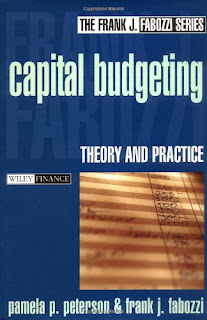
Capital Budgeting, 1st Edition, Pamela P. Peterson

http://www.amazon.com/gp/product/0471218332/ref=as_li_ss_tl?ie=UTF8&camp=1789&creative=390957&creativeASIN=0471218332&linkCode=as2&tag=bestaccounting-20


Capital investment decisions are a constant challenge to all levels of financial managers. Capital Budgeting: Theory and Practice shows you how to confront them using state-of-the-art techniques.

Broken down into four comprehensive sections, Capital Budgeting: Theory and Practice explores and illustrates all aspects of the capital budgeting decision process. Pamela Peterson and Frank Fabozzi examine the critical issues and limitations of capital budgeting techniques with an in-depth analysis of:

Classifying capital budgeting proposals
Determining the relevant cash flows for capital budgeting proposals
Assessing the economic value of a capital budgeting proposal using different techniques
Incorporating risk into the capital budgeting decision
Evaluating whether to lease or borrow-to-buy

Capital Budgeting: Theory and Practice provides the knowledge, insight, and advice that will allow you to handle one of the most important aspects of your firm's financial management. Advanced enough for practitioners yet accessible enough for the novice, Capital Budgeting: Theory and Practice is your complete guide to understanding and benefiting from the essential techniques of capital budgeting.

From the Inside Flap
Corporate financial managers continually invest funds in assets, and these assets produce income and cash flows that the firm will then either reinvest in more assets or pay to the owners. Capital investment refers to a firm's investment in assets, and these investments may be either short-term or long-term in nature. A capital budgeting decision involves the long-term commitment of a firm's scarce resources. When such a decision is made, the firm is committed to a current and possibly future outlay of funds.

Capital budgeting decisions play a prominent role in determining whether a firm will be successful. The commitment of funds to a particular capital project can be enormous and may be irreversible. While some capital budgeting decisions are routine and don't change the course or risk of a firm, there are strategic capital budgeting decisions that will either have an impact on the firm's future market position in its current product lines or permit it to expand into a new product line. The annals of business history are replete with examples of how capital budgeting decisions have turned the tide for a company.

In Capital Budgeting: Theory and Practice, Pamela Peterson and Frank Fabozzi discuss and illustrate the capital budgeting decision process. In Section I ("Making Investment Decisions and Cash Flows"), they cover the stages of the capital budgeting process (investment screening and selection, capital budgeting proposal, budgeting approval and authorization, project tracking, and postcompletion audit), classification of investment projects, and the critical task of cash flow estimation.

In Section II, Peterson and Fabozzi cover the techniques for evaluating capital budgeting proposals and for selecting projects. These techniques include payback and discounted payback techniques, net present value technique, profitability index technique, internal rate of return technique, and modified internal rate of return technique. Section III clearly explains the critical task of incorporating risk into the capital budgeting decision.

In the final section, Peterson and Fabozzi explain a common capital budgeting decision: the decision to buy an asset with borrowed funds or lease the same asset. This is the classic "lease versus borrow-to-buy decision." The coverage includes valuing a lease, how to incorporate uncertainty into the lease valuation, and how a firm should analyze a lease if it's in a current tax-paying position or has an operating loss to carry forward.

Capital budgeting is one of the most important, and sometimes most difficult, parts of financing. Through expert advice and questions and problems at the end of each section, Capital Budgeting: Theory and Practice provides a detailed explanation of capital budgeting that will allow you to excel in this area.

Product Details :
  • Series: Frank J. Fabozzi Series (Book 10)
  • Hardcover: 243 pages
  • Publisher: Wiley; 1 edition (February 2002)
  • Language: English
  • ISBN-10: 0471218332
  • ISBN-13: 978-0471218333
  • Product Dimensions: 0.9 x 6.1 x 9.2 inches

More Details about Capital Budgeting, 1st Edition

Monday, December 16, 2013

Advanced Management Accounting, 3rd Edition, Robert Kaplan

http://www.amazon.com/gp/product/0132622882/ref=as_li_ss_tl?ie=UTF8&camp=1789&creative=390957&creativeASIN=0132622882&linkCode=as2&tag=bestaccounting-20


Contains leading-edge treatment of innovative management accounting issues used by major companies throughout the world. Advanced Management Accounting provides a systematic management- oriented approach to advanced management topics. Each chapter is accompanied by cases to illustrate the concepts discussed. Written by an authoritative author team known for establishing innovative business standards. Includes an updated chapter on Transfer Pricing to reflect more modern approaches in addition to an entire chapter on Economic Value Added (EVA). Appropriate for business professionals involved in cost accounting and/or management.

From the Publisher
Focused on the finer-points of management accounting and actual work practices, this volume presents detailed and extensive coverage of the application of analytic techniques. --This text refers to the Hardcover edition.

From the Back Cover
Contains leading-edge treatment of innovative management accounting issues used by major companies throughout the world. Advanced Management Accounting provides a systematic management- oriented approach to advanced management topics. Each chapter is accompanied by cases to illustrate the concepts discussed. Written by an authoritative author team known for establishing innovative business standards. Includes an updated chapter on Transfer Pricing to reflect more modern approaches in addition to an entire chapter on Economic Value Added (EVA). Appropriate for business professionals involved in cost accounting and/or management.

MBA students alike may not even have the patient to read through it. But, as a management consultant in China ( i used to work for 2 of big 4 accounting firms, and now working as a freelance to help local companies to solve their managerial costing problems), this book is my primary reference for my work. I applied ideas in this book helping my clients building ABC and transfer pricing and costing control models. When you really need to solve true business problems (rather than reading in the school), you will find this is "the" book. In my view, you have to read Kaplan and Cooper's staff if you want to get some true knowledge about managerial accounting.

This book not classic. It contains chapters deal with subjects like performance evaluation and incentives in depth and by using advanced models. It also deals with ABC & ABM by using simle examples.

Product Details :
  • Paperback: 798 pages
  • Publisher: Prentice Hall; 3rd edition (February 6, 1998)
  • Language: English
  • ISBN-10: 0132622882
  • ISBN-13: 978-0132622882
  • Product Dimensions: 1.4 x 7.2 x 9.4 inches

More Details about Advanced Management Accounting, 3rd Edition

Friday, December 13, 2013

Accounting in a Nutshell, 3rd Edition: Accounting for the non-specialist (CIMA Professional Handbook), Janet Walker

http://www.amazon.com/gp/product/075068738X/ref=as_li_ss_tl?ie=UTF8&camp=1789&creative=390957&creativeASIN=075068738X&linkCode=as2&tag=bestaccounting-20


Designed primarily for middle and junior management who deal with financial information without really understanding the content; students who are studying accounting as a non-specialist subject, for example on a business studies or engineering course. The book serves as a basic reference to be used throughout the course.

It will also be particularly helpful in providing the basic grounding that is required before moving on to the more technical and in-depth study of the subject that may be required on some courses. Students who are embarking on a course of study to become a professional accountant will also find this book of major benefit.

In addition to revisions through out, a new new chapter 'Making long-term investment decisions' covering capital investment decisions, extends and rounds out the final part of the book: using Financial Information to Manage a Business. The chapter deals with the investment appraisal process and covers the main investment appraisal techniques from the point of view of a non-specialist: payback periods, accounting rate of return and discounted cash flow methods are just some of the new topics covered.

The focus will be on the level of understanding that a non-specialist requires in the work place as such, in keeping with the rest of the book, the chapter includes practical examples and exercises to enhance the reader's understanding.

* Jargon free and easy to understand - no prior knowledge of the subject necessary
* Focuses on the principles and use of accounting information
* Review questions to assess progress at each stage and many fully worked exercises and examples

About the Author
Janet Walker is a freelance lecturer and consultant, specialising in courses in Financial Awareness Trained as a management accountant with Brooke Bond Oxo Limited, qualifying as a Chartered Management Accountant (FCMA) in 1981. After seven years in industry, joined Croydon College in 1982 as a Senior Lecturer in management accounting and financial management. Studied for MBA at City University Business School in 1987/88. Worked as a full-time author for BPP Publishing Limited for eighteen months from 1990, responsible for writing and technical editing of a range of accountancy and marketing texts and workbooks. Set up own business in 1991 as a freelance lecturer and consultant, specialising in presenting courses in Financial Awareness for a variety of clients, including the Chartered Institute of Management Accountants (CIMA), the Institute of Chartered Accountants in England and Wales (ICAEW), City University Business School, V & A Museum, Markel International, National Lottery Heritage Fund, ICL Systems Service, Norwich Union, Weetabix Limited and the General Dental Council. Also providing financial planning and marketing consultancy services to small businesses. Other books published are primarily through BPP Publishing as above, and a number of CIMA Study Systems through CIMA Publishing.

This book covers both Financial and Management Accounting. It is an excellent introduction to the subject. It provides a great overview of the PURPOSE and USES of P&L Accounts (Income Statements), Balance Sheets, and Cash flow Statements.

It also has great information on how these are constructed.

It is NOT a practical guide to book-keeping. I highly recommend this, both for managers trying to understand financial and managerial accounting, and for students begging accounting.

Once you;ve read this, though, you will probably need to read a book on basic book-keeping to allow you to function as your own accountant, if that's your aim.

Product Details :
  • Series: CIMA Professional Handbook
  • Paperback: 368 pages
  • Publisher: CIMA Publishing; 3 edition (November 7, 2008)
  • Language: English
  • ISBN-10: 075068738X
  • ISBN-13: 978-0750687386
  • Product Dimensions: 0.8 x 6.1 x 9 inches

More Details about Accounting in a Nutshell, 3rd Edition: Accounting for the non-specialist (CIMA Professional Handbook)

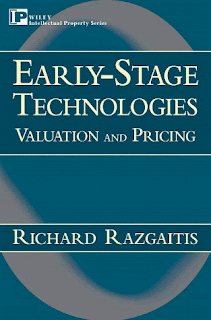
Early-Stage Technologies: Valuation and Pricing (Intellectual Property-General, Law, Accounting & Finance, Management, Licensing, Special Topics), 1st Edition, Richard Razgaitis

http://www.amazon.com/gp/product/0471328561/ref=as_li_ss_tl?ie=UTF8&camp=1789&creative=390957&creativeASIN=0471328561&linkCode=as2&tag=bestaccounting-20


From the Inside Flap
How is it possible to develop a licensing or purchase value for early-stage technology rights when there are no present customers, no historical data, no cash-flow data, and no demonstration of whether the technology in question will produce the next iMac or the next Edsel? What methods and criteria can potential buyers and sellers use to determine the value and appropriate price of products that are ahead of their time? Early-Stage Technologies is a comprehensive guide to technology risk assessment, valuation, and pricing. It describes in great detail the core concepts, sources of value, methods of valuation, issues involving equity realizations, and overall negotiation strategies to facilitate the licensing or sale of early-stage technologies; and it helps the developers of R&D to value their technologies based on their own needs and arrive at a price that is acceptable to both themselves and the potential buyer/licensee.

Drawing on his own diverse experience in developing, valuing, and licensing intellectual property, author Richard Razgaitis presents a realworld grounded approach to six key methods of valuing technology: use of industry standards, ratings/rankings method, rules of thumb, discounted cash flow, Monte Carlo and other advanced methods, and auctions. He describes the possible components involved in a licensing transaction: rights and other sources of value conveyed by the seller and money and other sources of value conveyed by the buyer, as well as a treatment of risks inherent in future projections. Finally, he explores how the value of licensing agreements can be structured and the principles upon which these structures can be negotiated. For licensing executives, corporate R&D departments, intellectual property consultants, university and government laboratories, attorneys, accountants, and business appraisers and executives, Early-Stage Technologies is a valuable resource that helps minimize uncertainties, characterize risks, and develop rational pricing models so that promising technologies are given every chance to realize their full potential.

From the Back Cover
Comprehensive coverage of the issues, methods, and art of valuing and pricing early-stage technologies To develop or not to develop; to license or not to license; what price will be a true reflection of the product's value from both the buyer's and seller's point of view? These questions are crucial to companies dependent on intellectual property-particularly technology companies, universities, and biotech companies. The risks associated with early-stage technology are high, and decisions must often be made years before any potential product will reach the market. In Early-Stage Technologies: Valuation and Pricing, Richard Razgaitis presents TR-R-A-DE(TM), a comprehensive approach to determining the future of new technologies based on technology rights, risk assignment, the art of deal-making, and deal economics. He considers the key components involved in a licensing transaction, offers a detailed presentation of six valuation methods for intellectual property, examines risk in both quantitative and qualitative terms, and explores the negotiation strategy and structuring of agreements that are the keys to the art of technology rights deal-making. Early-Stage Technologies is an indispensable tool for anyone involved in the development, valuation, and licensing of intellectual property, the most valuable resource and driving force of the information age.

About the Author
RICHARD RAZGAITIS is a consultant in licensing and technology commercialization. He is currently affiliated with IPC Group LLC, a company specializing in valuation and strategic management of intellectual property. For more than ten years he was Vice President of Technology Commercialization for Battelle and Bellcore, and involved in numerous license negotiations covering a broad range of technologies, from Advanced Materials and Processes to Software to Telecommunications and Networks. He has negotiated technology licenses with Fortune 50 companies as well as with 50-person companies, including spin-offs and start-ups. He has negotiated licenses in the U.S., Canada, Europe, and Asia.

I enjoyed reading Dr. Razgaitis book on the Early -Stage Technologies. It covered the different basic approaches to valuation. I specifically liked his analysis of the 25% rule and the Monte Carlo method for valuations. These two methods are on opposite ends of the difficulty spectrum of valuations. The details mentioned in those two methods has allowed me to strengthen the valuation reports that we do at Inavisis, Inc.

I also liked Chapter five which covers the Rating/ranking method to determine valuation. Although the chapter was general in nature, it outlined the basic principles that appraisal professional use in their valuation report and in litigation environment to support their analysis.

I use the stories outlined in the book in many of my valuation training courses. Dr. Razgaitis book is a must for the libraries of appraisal professional.

Sam Khoury

Product Details :
  • Series: Intellectual Property-General, Law, Accounting & Finance, Management, Licensing, Special Topics (Book 14)
  • Hardcover: 320 pages
  • Publisher: Wiley; 1 edition (October 8, 1999)
  • Language: English
  • ISBN-10: 0471328561
  • ISBN-13: 978-0471328568
  • Product Dimensions: 9.4 x 6.2 x 1.1 inches

More Details about Early-Stage Technologies: Valuation and Pricing (Intellectual Property-General, Law, Accounting & Finance, Management, Licensing, Special Topics), 1st Edition

Saturday, December 7, 2013

The Global Curse of the Federal Reserve: How Investors Can Survive and Profit From Monetary Chaos, 2nd Edition, Brendan Brown


The Global Curse of the Federal Reserve reveals and explores the missing link between the Austrian School of Economics and behavioral finance theory. Monetary instability is the source of the waves of irrational exuberance (sometimes described as "asset price inflation"), which spread so much economic destruction and geo-political turmoil when they break. The largest and most destructive waves in the past 100 years have all been powered by monetary turmoil created by the Federal Reserve. Dr. Brown argues that flawed monetary practice and principles—most recently in the form of Bernanke-ism—have been responsible for the Fed-made havoc.

The author comes to two optimistic conclusions. First, political forces in the US will one day gain sufficient strength to repeal Bernanke-ism. But the new revolutionaries must learn from the mistakes of the first monetarist revolution. Brown argues for the end of the Fed as a policy-making institution. Second, it is possible for investors to build substantial protection for their wealth and even profit from monetary chaos unleashed by the Federal Reserve—but this depends on throwing overboard much of the established wisdom about optimal portfolio management.

Review
"Since its founding, the Federal Reserve's oracles have cultivated and kept alive the myth that the world's most prominent central bank is a purveyor of domestic and international stability. Brendan Brown, a premiere market economist, draws on his deep knowledge of economics, history and markets to expose the Fed as a great destabilizing force. Brown shines a bright light on all the nonsensical ideas and arguments that have been peddled by Fed myth makers - both past and present. He scrutinizes and explodes ideas embraced by contemporary currency warriors, including the so-called global imbalance and savings glut problems, and, yes, inflation targeting. Once Brown disrobes the oracles, he then takes monetarism to a new level and unfurls a blueprint for monetary stability." - Steve H. Hanke, Professor of Applied Economics, The Johns Hopkins University, USA

About the Author
BRENDAN BROWN is an international economist practicing in London, UK. He has authored many books on international financial topics, including monetary problems in the US, Europe, and Japan, and asset market pricing (including exchange rates) in a global context. The books cover both contemporary trends and historical topics. He was awarded a PhD by the London School of Economics and an MBA by the University of Chicago. Dr. Brown is a regular contributor to Japanese and European financial media.

The book is very presents a very clear analysis of the problems created by central bank manipulation of the money supply. It provides an interesting history of the Fed's behavior and its consequences from its inception. If you are interested in the effect of central banking, and particularly the Fed, on an economy, you won't want to miss this book. If you liked Lords of Finance, Bankers Who Broke the World, you will like this book.

Product Details :

  • Paperback: 240 pages
  • Publisher: Palgrave Macmillan; Second Edition,Revised Edition,2nd edition edition (March 1, 2013)
  • Language: English
  • ISBN-10: 1137297395
  • ISBN-13: 978-1137297396
  • Product Dimensions: 0.6 x 5.5 x 8.5 inches


More Details about The Global Curse of the Federal Reserve: How Investors Can Survive and Profit From Monetary Chaos, 2nd Edition

Financial Modelling with Jump Processes (Chapman & Hall/CRC Financial Mathematics Series), 1st Edition, Peter Tankov


WINNER of a Riskbook.com Best of 2004 Book Award!

During the last decade, financial models based on jump processes have acquired increasing popularity in risk management and option pricing. Much has been published on the subject, but the technical nature of most papers makes them difficult for nonspecialists to understand, and the mathematical tools required for applications can be intimidating. Potential users often get the impression that jump and Lévy processes are beyond their reach.

Financial Modelling with Jump Processes shows that this is not so. It provides a self-contained overview of the theoretical, numerical, and empirical aspects involved in using jump processes in financial modelling, and it does so in terms within the grasp of nonspecialists. The introduction of new mathematical tools is motivated by their use in the modelling process, and precise mathematical statements of results are accompanied by intuitive explanations.

Topics covered in this book include: jump-diffusion models, Lévy processes, stochastic calculus for jump processes, pricing and hedging in incomplete markets, implied volatility smiles, time-inhomogeneous jump processes and stochastic volatility models with jumps. The authors illustrate the mathematical concepts with many numerical and empirical examples and provide the details of numerical implementation of pricing and calibration algorithms.

This book demonstrates that the concepts and tools necessary for understanding and implementing models with jumps can be more intuitive that those involved in the Black Scholes and diffusion models. If you have even a basic familiarity with quantitative methods in finance, Financial Modelling with Jump Processes will give you a valuable new set of tools for modelling market fluctuations.

Review
Pardon the pun, but I jumped at the opportunity to endorse this book. This book is the first complete treatment of markets rendered incomplete by the reality of jumps in prices and volatilities. If I were you, I would pounce. -Dr. Peter Carr, Head of Quantitative Research, Bloomberg LP and Director of Masters Program in Mathematical Finance, NYU

This book is an extremely rich source of information…the content speaks for itself… ISI Short Book Reviews

This book is an extremely rich source of information for recent developments in the use of jump processes in financial modelling, in particular the use of lËvy processes. The authors work at a comfortable mathematical pace choosing carefully which proofs to include and exclude and never losing sight of financial interpretation and application.

The authors conclude the main body of their text by saying: We hope that the present volume will encourage more researchers and practitioners to contribute to this topic and improve on our understanding of theoretical, numerical and practical issues related to financial modelling with jump processes. I am quite convinced that this goal will be achieved. - Dr. Andreas E. Kyprianou in the 'International Statistics Institute' book reviews

What makes this book attractive is its comprehensiveness....this is an excellent book. Read it. You will learn much. - Glyn A.Holton of 'Contingency Analysis'

One of the first texts which is entirely devoted to option pricing with non-continuous jump-type stochastic processes… an easygoing presentation where the basic problems of jump models are not additionally obscured by technicalities. - Journal of the Royal Statistics

I love this book. It will be required reading for students entering Levy finance. My judgement is that it will be useful both within academia, particularly to people in stochastics, econometrics, and other fields wanting to develop an interest in finance, and to practitioners. --N.H. Bingham, Journal of the American Statistical Association

About the Author
Columbia University, New York, USA Universite Paris VII, France University of Maryland, College Park, USA University of Cambridge and Cambridge Systems Associates Limited, UK --This text refers to an alternate Hardcover edition.

Product Details :

  • Series: Chapman & Hall/CRC Financial Mathematics Series (Book 2)
  • Hardcover: 552 pages
  • Publisher: Chapman and Hall/CRC; 1 edition (December 30, 2003)
  • Language: English
  • ISBN-10: 1584884134
  • ISBN-13: 978-1584884132
  • Product Dimensions: 1.3 x 6.5 x 9.5 inches


More Details about Financial Modelling with Jump Processes (Chapman & Hall/CRC Financial Mathematics Series), 1st Edition

Friday, December 6, 2013

Risk Management, 1st Edition, Michel Crouhy


This is the all-in-one banker's and financial manager's guide for implementing and using an effective risk management program. In today's world of multibillion-dollar credit losses and bailouts, it has become increasingly imperative for corporate and banking leaders to monitor and manage risk on all fronts. "Risk Management" introduces and explores the latest financial and hedging techniques in use around the world, and provides the foundation for creating an integrated, consistent, and effective risk management strategy.

The tested and comprehensive analysis and insights in "Risk Management" give bankers and financial managers all the necessary information for: Risk Management Overview - from the history of risk management to the new regulatory and trading environment, a look at risk management past and present; Risk Management Program Design - techniques to organize the risk management function, and design a system to cover your organization's many risk exposures; and, Risk Management Implementation - how to use the myriad systems and products value at risk (VaR), stress-testing, derivatives, and more for measuring and hedging risk in today's marketplace. In the financial world, the need for a dedicated risk management framework is a relatively recent phenomenon. But as the Long-Term Capital Management and BankAmerica crises attest, lack of up-to-date knowledge concerning its many components can be devastating.For financial managers in both the banking and business environments, "Risk Management" will introduce and illustrate the many aspects of modern risk management and strengthen every financial risk management program. Exploding global competition, increasing regulations, and the ever-changing product mix of innovative, intricate derivative and securitization products have pushed risk management to the forefront of today's financial landscape. Corporate and banking executives trying to make sense of this environment often find themselves wasting valuable time searching for details and actually creating risk through innocent misinterpretations or misguided hedging strategies. "Risk Management" consolidates the entire field of corporate risk administration from data and technological infrastructure to investment and hedging strategies that include innovative derivatives credit risk securitization techniques into one all-inclusive, easily accessible reference.

Michel Crouhy, Dan Galai, and Robert Mark, seasoned finance professionals with an unmatched breadth of experience covering banking, corporate, and academic risk management applications walk you through risk management with the focus on concrete, results-oriented tips and analysis. The result is, quite frankly, the only reference you'll need for a quick, thorough understanding of today's complex financial risk management challenges.Look to the expert analysis and proven suggestions in "Risk Management" for a no-nonsense overview of: Integrated Risk Management - how to understand and develop the necessary tools for measuring and managing all of your firm's risk in terms of a common unit; Regulatory Environment - group of 30 (G-30) policy recommendations, BIS 1998 models, and the standardized approach proposed by the Basle Committee; Market Risk- new rules set by the SEC for traded companies to disclose their risk management policies and quantify their exposure to market risk; Practical Measurement Issues - utilizing historical, implied, and stochastic models to measure volatility, plus helpful summaries of measuring correlations and the yield curve; and, Future Considerations - expected conditions and effects of the BIS 2000+ Accord, with review of the G-12 recommendations to improve counter party risk management practices.

Never before have the fields of banking and corporate financial risk management been as complicated and the stakes as unyielding. Whether used as an essential resource for institutional financial risk management, a comprehensive text for courses concentrating on bank risk management, or simply as an unprecedented reference covering every important aspect of the discipline, "Risk Management" will bring you up-to-date on an area that promises to increase in importance as we enter the uncharted waters of the 21st century.

From the Back Cover
The All-in-One Banker’s and Financial Manager’s Guide for Implementingæand Usingæan Effective Risk Management Program In today’s world of multibillion-dollar credit losses and bailouts, it has become increasingly imperative for corporate and banking leaders to monitor and manage riskæon all fronts. Risk Management introduces and explores the latest financial and hedging techniques in use around the world, and provides the foundation for creating an integrated, consistent, and effective risk management strategy.

The tested and comprehensive analyses and insights in Risk Management give bankers and financial managers all the necessary information for: * Risk Management Overview--From the history of risk management to the new regulatory and trading environment, a look at risk management past and present * Risk Management Program Design--Techniques to organize the risk management function, and design a system to cover your organization’s many risk exposures * Risk Management Implementation--How to use the myriad systems and productsævalue at risk (VaR), stress-testing, derivatives, and more for measuring and hedging risk in today’s marketplace

In the financial world, the need for a dedicated risk management framework is a relatively recent phenomenon. But as the Long-Term Capital Management and BankAmerica crises attest, lack of up-to-date knowledge concerning its many components can be devastating. For financial managers in both the banking and business environments, Risk Management will introduce and illustrate the many aspects of modern risk managementæand strengthen every financial risk management program.

Exploding global competition, increasing regulations, and the ever-changing product mix of innovative, intricate derivative and securitization products have pushed risk management to the forefront of today’s financial landscape. Corporate and banking executives trying to make sense of this environment often find themselves wasting valuable time searching for detailsæand actually creating risk through innocent misinterpretations or misguided hedging strategies.

Risk Management consolidates the entire field of corporate risk administrationæfrom data and technological infrastructure to investment and hedging strategies that include innovative derivatives credit risk securitization techniquesæinto one all-inclusive, easily accessible reference. Michel Crouhy, Dan Galai, and Robert Markæseasoned finance professionals with an unmatched breadth of experience covering banking, corporate, and academic risk management applicationsæwalk you through risk management with the focus on concrete, results-oriented tips and analysis.

The result is, quite frankly, the only reference you’ll need for a quick, thorough understanding of today’s complex financial risk management challenges. Look to the expert analysis and proven suggestions in Risk Management for a no-nonsense overview of: * Integrated Risk Management--How to understandæand develop the necessary tools for measuring and managing all of your firm’s risk in terms of a common unit * Regulatory Environment--Group of 30 (G-30) policy recommendations, BIS 1998 models, and the standardized approach proposed by the Basle Committee * Market Risk--New rules set by the SEC for traded companies to disclose their risk management policies and quantify their exposure to market risk * Practical Measurement Issues--Utilizing historical, implied, and stochastic models to measure volatility, plus helpful summaries of measuring correlations and the yield curve * Future Considerations--Expected conditions and effects of the BIS 2000+ Accord, with review of the G-12 recommendations to improve counterparty risk management practices

Never before have the fields of banking and corporate financial risk management been as complicatedæand the stakes as unyielding. Whether used as an essential resource for institutional financial risk management, a comprehensive text for courses concentrating on bank risk management, or simply as an unprecedented reference covering every important aspect of the discipline, Risk Management will bring you up-to-date on an area that promises to increase in importance as we enter the uncharted waters of the 21st century.

About the Author
Michel Crouhy, Ph.D., is senior vice president, Global Analytics, Risk Management Division at Canadian Imperial Bank of Commerce (CIBC), where he is in charge of market and credit risk analytics. He has published extensively in academic journals, is currently associate editor of both Journal of Derivatives and Journal of Banking and Finance, and is on the editorial board of Journal of Risk.

Dan Galai, Ph.D., is the Abe Gray Professor of Finance and Business Administration at the Hebrew University and a principal of Sigma P.C.M. Dr. Galai has consulted for the Chicago Board Options Exchange and the American Stock Exchange and published numerous articles in leading journals. He was the winner of the First Annual Pomeranze Prize for excellence in options research presented by the CBOE.

Robert Mark, Ph.D., is senior executive vice president at the Canadian Imperial Bank of Commerce. Dr. Mark is the chief risk officer at CIBC and is a member of the senior executive team of the bank. In 1998, he was named Financial Risk Manager of the Year by the Global Association of Risk Professionals (GARP).

Product Details :

  • Hardcover: 752 pages
  • Publisher: McGraw-Hill; 1 edition (October 30, 2000)
  • Language: English
  • ISBN-10: 0071357319
  • ISBN-13: 978-0071357319
  • Product Dimensions: 2.1 x 6.2 x 9.1 inches


More Details about Risk Management, 1st Edition

Wednesday, December 4, 2013

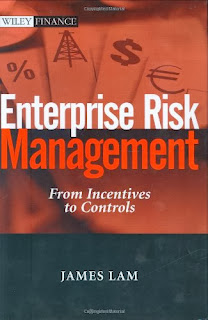
Enterprise Risk Management: From Incentives to Controls, 1st Edition, James Lam

http://www.amazon.com/gp/product/0471430005/ref=as_li_ss_tl?ie=UTF8&camp=1789&creative=390957&creativeASIN=0471430005&linkCode=as2&tag=bestaccounting-20


From the Inside Flap
Enterprise risk management is a complex yet critical issue that all companies must deal with as they head into the twenty-first century. It empowers you to balance risks with rewards as well as people with processes. But to master the numerous aspects of enterprise risk management, you must intergrate risk management into the culture and operations of the business. No one knows this better than risk management expert James Lam. In Enterprise Risk Management: From Incentives to Controls, Lam distills twenty years worth of experience in this field to give you a clear understanding of both the art and science of enterprise risk management.

Organized into four comprehensive sections, Enterprise Risk Management offers in-depth insights, practical advice, and real-world case studies that explore every aspect of this important field. Section I: "Risk Management in Context" provides an introduction and foundation for the rest of the book. You’ll learn why a company should strive for balance between risk and return, and discover some of the basic reasons why risk management is such an important issue in business today. You’ll also learn seven essential risk management lessons through discussions of some of the major financial disasters of years past. With this knowledge in hand, you’ll be introduced to some of the key concepts, processes, and tools underlying risk management.

In Section II: "The Enterprise Risk Management Framework," you’ll receive an executive education on the business rationale for integrating risk management processes, and discover the seven building blocks for developing an enterprise risk management program. You’ll also discover how the role of Chief Risk Officer has changed in today’s firm.

Section III: "Risk Management Applications" discusses the applications of risk management in two dimensions–functions and industries. You’ll become familiar with the functional requirements for credit, market, and operational risks, as well as learn how risk management has evolved from a control function to a function that enables performance optimization. Industry segments including financial institutions, energy firms, asset management firms, and nonfinancial corporations are also explored with an eye toward key business trends and risk management requirements in these sectors.

Section IV: "A Look to the Future" rounds out this comprehensive discussion of enterprise risk management by examining emerging topics in risk management with respect to people and technology. A forward-looking story reveals how best-practice risk management might look in the year 2010.

Failure to properly manage risk continues to plague corporate America–from Enron to Long-Term Capital Management. Don’t let it hurt your organization. Pick up Enterprise Risk Management and learn how to meet the enterprise-wide risk management challenge head on–and succeed.

From the Back Cover
Praise for Enterprise Risk Management

"In the aftermath of Enron, WorldCom, and Sarbanes-Oxley, every publicly traded company should be concerned about risk management. This book takes a pragmatic approach to risk management that can benefit any CEO or senior executive. Lam lays out clear strategies to address what is often a highly complex issue." –William L. Walton, Chairman and CEO, Allied Capital Corporation

"James Lam provides one of the most practical, insightful books on risk management that I have read in the last thirty years. It clearly reflects experience and deep understanding of the art as well as the science in risk management practices. A must-read for all who wish to advance risk management practices in their businesses." –Sandra Jansky, Executive Vice President, Chief Credit Officer, SunTrust Banks, Inc. Chairperson, Risk Management Association

"In this book, James Lam has provided an effective overview of business risk. Enterprise Risk Management will be useful to professional risk managers and business executives seeking to understand the latest tools and organizational approaches." –Robert Simons, Charles M. Williams Professor of Business Administration, Unit Head–Accounting & Control, Harvard Business School

"The most comprehensive and engaging handbook on enterprise risk management, written by the pioneer of the Chief Risk Officer function. Filled with practical examples and lessons learned, this book is destined to become one of the most widely read primers on today’s top business initiative. James Lam is the authority on enterprise risk management, and I highly recommend this book to all board directors, senior executives, and risk managers." –Cassandra R. Schultz, Vice President and Chief Risk Officer, KeySpan Corporation

"James Lam’s book Enterprise Risk Management: From Incentives to Controls provides an insightful road map to best practices in risk management. Based on a solid and successful career in risk management, James’s advice is both timely and relevant and should be required reading for all risk management professionals." –Michael J. Litwin, Chief Credit and Risk Officer, Merrill Lynch Capital

About the Author
JAMES LAM is President of James Lam & Associates, an independent risk advisory firm. Before starting his own firm, Lam was founder and president of ERisk and partner of Oliver, Wyman & Company. In 1997, as Chief Risk Officer at Fidelity Investments, he was named the first-ever Financial Risk Manager of the Year by the Global Association of Risk Professionals. Prior to Fidelity, he was chief risk officer of Capital Markets Services, Inc., a GE Capital Company. Lam graduated with honors from Baruch College and received his MBA from UCLA. He is also currently an Adjunct Professor of Finance at Babson College.

Product Details :
  • Series: Wiley Finance (Book 181)
  • Hardcover: 336 pages
  • Publisher: Wiley; 1 edition (May 16, 2003)
  • Language: English
  • ISBN-10: 0471430005
  • ISBN-13: 978-0471430001
  • Product Dimensions: 1.1 x 6.1 x 9.1 inches

More Details about Enterprise Risk Management: From Incentives to Controls, 1st Edition

Tuesday, December 3, 2013

Core Concepts of Accounting, 2nd Edition, Cecily A. Raiborn


Raiborn arms accountants with the resources they need to understand key financial and managerial accounting concepts. Visual Recaps are provided to illustrate significant topics in a pictorial manner or summarized in a table. Each chapter contains a summary, key terms list, and a variety of questions, exercises, problems, and short cases. Accounting Information for Decision Making sections are designed to emphasize a user perspective of accounting information. Accountants will also find discussions of international financial reporting standards (IFRSs) to gain a global perspective.

It can get a little confusing, this accounting stuff, but this book uses a lot of examples and has a lot of practice at the end of each chapter.

On time and exactly what I needed. It was in great shape. I will be able to sale this product with how nice it is.

I used this textbook in my first accounting class. The book was easy to read and the problems at the end of the chapter were not too difficult but helped me understand the material better. There were a number of errors in the text and problems but most of them were obvious and easy to see. It would have been nice for the editor to catch these before printing.

You can judge a book by it's cover. This book is too short, the topics are over simplified,and you can't do the homework w/o serious help from someone that already knows accounting. In no way does it teach you anything. The homework at the end of the chapter is difficult. You can't go back to the text to do the homework. If you don't have a good teacher, you are up a creek without a paddle. It's a cheap book brought to you by the publishers that are responsible for some of the Idiot books. It does not belong in a graduate level program.

Product Details :

  • Paperback: 464 pages
  • Publisher: Wiley; 2 edition (November 3, 2009)
  • Language: English
  • ISBN-10: 0470499478
  • ISBN-13: 978-0470499474
  • Product Dimensions: 0.6 x 7.4 x 9.2 inches


More Details about Core Concepts of Accounting, 2nd Edition

Friday, November 29, 2013

The Market Approach to Valuing Businesses, 2nd Edition, Shannon P. Pratt


From the Inside Flap
The market approach is an increasingly popular way to determine a business's value—for both buyers and sellers. Praised for its objectivity, this approach reviews the annual sales and other financial variables of comparable businesses for guidance in valuation. When well implemented, the market approach is the model most favored by the IRS and the United States Tax Court.

You could say that Shannon Pratt wrote the book on the market approach. Published in 2000, his groundbreaking book The Market Approach to Valuing Businesses set the standards and explained the theory and methodology for this evolving approach. Expanded and updated to encompass the latest rulings and source data, the new Second Edition is an indispensable reference for beginning and experienced appraisers, intermediaries, buyers, sellers, attorneys, CPAs, or judges. It covers:

Both The Guideline Public Company Method and The Merger & Acquisition (Transaction) Method
A discussion of past transactions, offers to buy, rules of thumb, and buy-sell agreements
Pricing for purchases and sales
Valuation for gift and estate taxes and marital dissolution
Shareholder matters, including dissenting stockholder suits and resolutions of value under buy-sell agreements
How to find and analyze comparative market transaction data
Analysis of the most recent cases in family law, tax, and shareholder dispute courts

Complete with sample cases, an extensive bibliography, an appendix on data resources, the Quantitative Marketability Discount Model, and a list of business brokers and their specialties, The Market Approach to Valuing Businesses is an authoritative, state-of-the-art treatise for both valuation professionals and nonprofessionals.

From the Back Cover
Your Best Approach to Determining Value If you're buying, selling, or valuing a business, how can you determine its true value? By basing it on present market conditions and sales of similar businesses. The market approach is the premier way to determine the value of a business or partnership. With convincing evidence of value for both buyers and sellers, it can end stalemates and get deals closed. Acclaimed for its empirical basis and objectivity, this approach is the model most favored by the IRS and the United States Tax Court—as long as it's properly implemented.

Shannon Pratt's The Market Approach to Valuing Businesses, Second Edition provides a wealth of proven guidelines and resources for effective market approach implementation. You'll find information on valuing and its applications, case studies on small and midsize businesses, and a detailed analysis of the latest market approach developments, as well as:

A critique of US acquisitions over the last twenty-five years
An analysis of the effect of size on value
Common errors in applying the market approach
Court reactions to the market approach and information to help you avoid being blindsided by a litigation opponent

Must reading for anyone who owns or holds a partial interest in a small or large business or a professional practice, as well as for CPAs consulting on valuations, appraisers, corporate development officers, intermediaries, and venture capitalists, The Market Approach to Valuing Businesses will show you how to successfully reach a fair agreement—one that will satisfy both buyers and sellers and stand up to scrutiny by courts and the IRS.

About the Author
Shannon P. Pratt, CFA, FASA, MCBA, CM&AA, is the Chairman and CEO of Shannon Pratt Valuations, Inc. a premier business valuation firm located in Portland Oregon, and is the founder and Editor Emeritus of Business Valuation Resources, LLC. Over a distinguished career of close to four decades, he has performed valuation engagements for M&A, ESOPs, gift and estate taxation, marital dissolution, shareholder oppression and dissent, and numerous other purposes. He has conducted numerous fairness and solvency opinions, has testified in a wide variety of federal and state courts across the country, and frequently participates in arbitration and mediation proceedings. Dr. Pratt is one of the most successful and respected authors in his field. He is the author or coauthor of several industry standards, including Valuing a Business: The Analysis and Appraisal of Closely Held Companies, Valuing Small Businesses and Professional Practices, The Market Approach to Valuing Businesses, Standards of Value, Business Valuation and Taxes, The Lawyer's Business Valuation Handbook, and Cost of Capital.

Product Details :

  • Hardcover: 432 pages
  • Publisher: Wiley; 2 edition (November 25, 2005)
  • Language: English
  • ISBN-10: 0471696544
  • ISBN-13: 978-0471696544
  • Product Dimensions: 1.4 x 6.3 x 9.1 inches


More Details about The Market Approach to Valuing Businesses, 2nd Edition

Wednesday, November 27, 2013

Loose Leaf Fundamental Financial Accounting Concepts with Connect Plus, 4th Edition, Thomas Edmonds


Students are often overwhelmed by the amount of information presented in the introductory financial accounting course. By focusing on fundamental concepts in a logical sequence, students are able to fully comprehend the material rather than memorize seemingly unrelated terms and topics. The goal of Fundamental Financial Accounting Concepts is to enable students to understand how any given business event affects the financial statements. The "financial statements model" is a highly praised feature because it allows students to visualize the simultaneous impact of business events on all of the key financial statements (the income statement, the balance sheet, and the statement of cash flows).

About the Author
Thomas P. Edmonds, Ph.D.: Dr. Edmonds is Professor of Accountancy at the University of Alabama at Birmingham, (UAB). He has been actively involved in teaching accounting principles throughout his academic career. He has received several prestigious teaching awards, including the UAB President’s Excellence in Teaching Award and the distinguished Ellen Gregg Ingalls Award for excellence in classroom teaching. His academic experience includes being published in the Journal of Accounting Education, the Accounting Review, and the Journal of Accounting, Auditing and Finance among others. Dr. Edmonds received his Ph.D. in Accounting from Georgia State University.

Frances M. McNair, Ph.D., CPA: Dr. McNair holds the KPMG Peat Marwick Professorship of Accounting at Mississippi State University, (MSU) and received her Ph.D. in Accounting from the University of Mississippi. Her research has been published in the Journal of Accountancy, Management Accounting, and the Business and Professional Ethics Journal.

Philip R. Olds, Ph.D., CPA: Dr. Olds is Professor of Accounting at Virginia Commonwealth University, and received his Ph.D. from Georgia State University.

Don't throw away the plastic wrap- it has a card with the connect code in it! Of course, ours is gone so my husband will have to purchase a membership separately. Bummer. Also, the loose leaf is flimsy, as expected. The pages, particularly the first and last, have already fallen out of the three ring binder. I have to now go buy hole reinforcers to keep the rest of the book together. For the extra money I wish we bought the regular text book. Live and learn.

As for content- typical introductory accounting book. It's required, not as if we can choose which to buy. So enjoy?

Product Details :

  • Loose Leaf
  • Publisher: McGraw-Hill/Irwin; 4 edition (June 1, 2011)
  • Language: English
  • ISBN-10: 0077924428
  • ISBN-13: 978-0077924423
  • Product Dimensions: 1.1 x 8.3 x 10.6 inches


More Details about Loose Leaf Fundamental Financial Accounting Concepts with Connect Plus, 4th Edition

Accounts Payable Best Practices (Wiley Best Practices), 1st Edition, Mary S. Schaeffer


From the Inside Flap
The fundamental structure of the accounts payable function reflects a company’s financial integrity, yet so many payable operations in companies aren’t running at peak efficiency. Overlooking only a few weak accounts payable operations can adversely affect a company’s bottom line in a number of ways, from incurring costs to resolve discrepancies and fix errors to receiving fines for failing to comply with escheat or sales and tax rules. Accounts Payable Best Practices provides businesses and other organizations with a strong sense of where they stand against industry leaders and shows them how to take their services and organizational processes to state-of-the-art levels. Documented strategies and tactics employed by highly admired companies are presented–both successful and unsuccessful–to illustrate the real-world functionality of each process and approach.

Every chapter features a brief explanation of the process or topic being addressed to accompany the discussion of best practices. However, for a variety of reasons, some firms aren’t in a position to employ best practices. To bridge the gap between the latest theory and practice, Accounts Payable Best Practices identifies "Almost Best Practices." These special sections consider that not all practices will work at every company, and they offer successful alternatives to best practices. Also included are discussions on practices that absolutely should not be used, but may be practiced at other companies.

To address the renewed interest in internal audit and controls, such as the Sarbanes-Sarbanes-Oxley Act, the mundane operational aspects of accounts payable are reviewed in a way that focuses attention on issues that are sometimes ignored, such as the master vendor file. Other coverage in Accounts Payable Best Practices includes:

Innovative T&E techniques used at successful companies P-cards–an easy-to-understand innovation that is being adopted by companies everywhere 1099 reporting, sales and use tax handling and reporting, and unclaimed property Cash management initiatives that are increasingly falling on the shoulders of the accounts payable departments Case studies demonstrating how best practice helped real-world companies achieve outstanding results Accounts Payable Best Practices is an essential resource for accounts payable managers, controllers, and CFOs at every size company.

From the Back Cover
Praise for Accounts Payable Best Practices "Given the rapidly changing responsibilities of accounts payable operations, it’s critical to have a resource to keep you up to date–Accounts Payable Best Practices is that resource. Each chapter covers one area, identifying and explaining best practices and pinpointing worst practices that you should avoid. By implementing the recommended systems and processes, you can improve the efficiency and effectiveness of your department." —Jon Casher, Chairman, RECAP, Inc.

"Mary Schaeffer is the leading author on accounts payable practices. This book provides a complete compilation of practical advice on how an accounts payable department can improve the bottom line. You can pay thousands of dollars to consulting firms to learn the latest buzzwords about business processes, or you can buy this book and get practical tips for implementation." —Dr. Will Yancey, CPA, Independent Consultant

About the Author
Mary S. Schaeffer is the Editorial Director and Publisher of Accounts Payable Now & Tomorrow, a newsletter devoted to payment issues. She also pens, e-News from the AP Front, a complimentary e-zine for the payment community. She's the author of ten books and numerous magazine, newsletter and newspaper articles. Her books have been used in several certification programs. She is a member of the New York Financial Writers Association. She is currently working on two additional books for John Wiley & Sons.

The book is a good intro to AP best practices but it is missing the comprehensive approach of looking at the processes and policies end to end. This approach is what is needed to have drive transformational change, otherwise, AP department might change a process and have a negativeimpacted on the business or Procurement.

Product Details :

  • Series: Wiley Best Practices
  • Hardcover: 256 pages
  • Publisher: Wiley; 1 edition (April 26, 2004)
  • Language: English
  • ISBN-10: 0471636959
  • ISBN-13: 978-0471636953
  • Product Dimensions: 0.9 x 6.1 x 9.1 inches


More Details about Accounts Payable Best Practices (Wiley Best Practices), 1st Edition